

Our Verdict
Open shelving delivers genuine savings and a lighter, more open feel when it fits the household's habits. The trade-off is real maintenance work and less forgiveness for clutter. Households that cook heavily, have young children, or prefer a low-maintenance kitchen may find the aesthetic appeal fades fast.
Organized households comfortable with regular tidying who want to reduce cabinet costs and create a more open kitchen feel.
What open shelving actually means for your kitchen
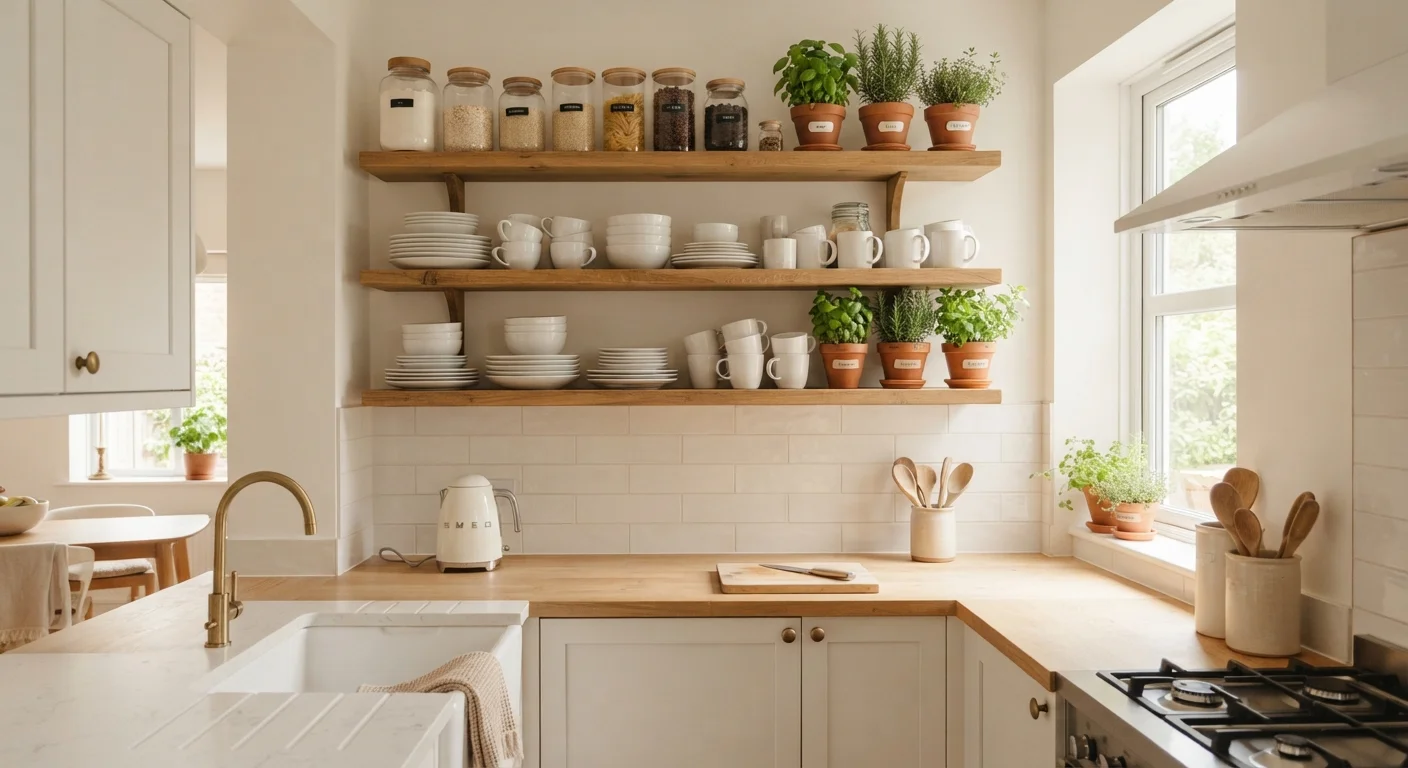
Open shelving replaces upper cabinet boxes with wall-mounted shelves, leaving dishes, glasses, and pantry items fully visible. The style has been popular in kitchen renovations for years because it photographs well and costs less than a full set of upper cabinets. Before pulling cabinets off the wall, it helps to understand what you are actually trading away and what you genuinely gain.
This is not an all-or-nothing decision. Many kitchens use a mix: open shelves in one or two zones, closed cabinets elsewhere. That hybrid approach lets you test the look without committing your entire storage plan to it. See how to prioritize kitchen upgrades on a tight budget if you are weighing this against other renovations.
The real advantages
Lower cost than upper cabinets
Wall shelves cost a fraction of installed cabinet boxes, freeing budget for other kitchen upgrades.
Everything is visible and within reach
No doors mean faster access to everyday items and no searching through stacked cabinet contents.
Makes small kitchens feel less enclosed
Removing upper cabinet boxes opens sightlines and lets more light move through the space.
Easier to change and update
Swapping shelf brackets or staining a shelf is simpler and cheaper than replacing cabinet doors.
Cost is the clearest argument for open shelving. Stock upper cabinets run anywhere from $100 to $300 per linear foot installed. Wall-mounted shelves, even solid wood ones, typically cost a fraction of that. For a budget kitchen refresh, the savings can be substantial and redirect money toward countertops, lighting, or appliances.
Accessibility matters too. When everything is visible, you stop hunting through cabinet stacks for the right lid or the rarely used serving bowl. Items you reach for daily are right there, no doors to open, no digging required.
The real disadvantages
Dust and grease accumulate constantly
Cooking releases airborne grease and particles that settle on exposed dishes and shelves, requiring frequent wiping.
Clutter is always visible
Unlike closed cabinets, open shelves put mismatched or disorganized items on permanent display.
Less total storage capacity
Shelves hold fewer items than deep cabinet boxes, which can create real storage shortfalls in smaller kitchens.
Wall patching adds upfront cost
Removing cabinets often exposes damaged or unfinished drywall that needs patching and repainting before shelves go up.
Poor fit for heavy-use or humid kitchens
Steam from boiling and heavy frying accelerates residue buildup and can warp wood shelves over time.
Dust and grease are the two things most people underestimate. Kitchen air carries cooking residue, and exposed shelves collect it constantly. Dishes left out between uses will need rinsing before you use them if the shelf goes weeks without a wipe-down. Households that cook daily with high heat or strong aromatics will notice this faster.
Clutter is also unforgiving. A closed cabinet hides mismatched containers and odds and ends. An open shelf puts everything on display, which means staying organized is not optional. If your current cabinets are cluttered, open shelves will not improve the situation; they will make it more visible. The same discipline that makes DIY home projects go wrong applies here: the maintenance phase matters more than the installation day.
Rentals and lease agreements
If you rent your home, check your lease before removing or altering any cabinets. Most standard leases require you to return the unit to its original condition, meaning removed cabinets would need to go back up at move-out. Freestanding shelving units are a non-destructive alternative that achieves a similar look without permanent changes.
Practical things to check before removing cabinets
Wall condition matters more than most guides mention. Upper cabinets often hide patched drywall, mismatched paint, or even rough framing from previous renovations. Removing cabinets means dealing with whatever is behind them, which could add painting or patching costs to a job that looked simple on paper.
Bracket placement has to hit wall studs. Shelves loaded with heavy ceramic dishes or cast iron pans can pull free of drywall anchors alone, especially if the shelves are deep. A stud finder and proper lag bolts into framing are not optional for anything that will hold real weight.
Check whether your kitchen has enough closed storage elsewhere before committing. Pots, pans, cleaning supplies, and food you buy in bulk need to go somewhere that is not on display. If your lower cabinets are already crowded, losing upper storage will create a practical problem that no amount of styling fixes. For more on making small budgets work across a full room, affordable wall treatments can complement open shelving without adding storage pressure.
$100-$300
Per linear foot for installed upper cabinets
General contractor pricing ranges cited across home improvement industry estimates for stock and semi-custom upper cabinet installation.
~30%
Typical upper cabinet share of kitchen storage
Upper cabinets generally account for roughly a third of a kitchen's total storage volume, which open shelving must compensate for.
Who should and should not try open shelves
Open shelving works best when the household already keeps a tidy kitchen, owns dishware that looks reasonable grouped together, and cooks at a frequency that naturally rotates items on the shelf. If dishes come down and go back up regularly, dust does not accumulate in the same way.
It is a harder sell for households with young children who will reach for anything at eye level, renters who cannot patch walls when they move out, or anyone who runs the kitchen as a high-volume cooking space with daily frying and sauteing. The cleaning burden in those situations is not trivial.
A shelf or two above a coffee station or a single open section next to the stove for oils and spices carries most of the visual benefit with far less exposure. That middle-ground approach gets the open look in one focal zone without requiring the whole kitchen to stay display-ready at all times.
The content provided on our blog site traverses numerous categories, offering readers valuable and practical information. Readers can use the editorial team’s research and data to gain more insights into their topics of interest. However, they are requested not to treat the articles as conclusive. The website team cannot be held responsible for differences in data or inaccuracies found across other platforms. Please also note that the site might also miss out on various schemes and offers available that the readers may find more beneficial than the ones we cover.