

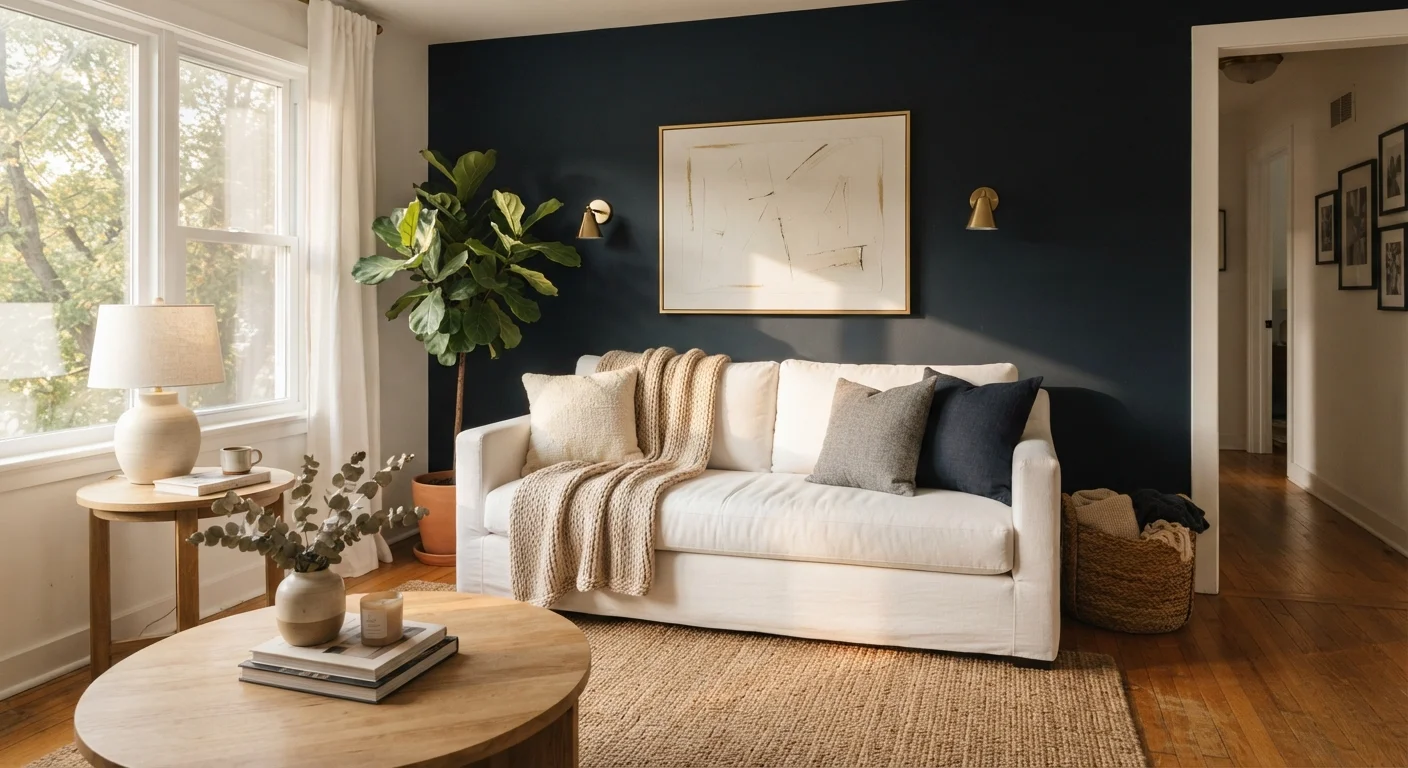
Why accent walls work so well on a budget
An accent wall concentrates visual interest on one surface instead of four, which means less material, less time, and a stronger design statement for the money spent. The technique suits renters and owners alike because many options are reversible, and even permanent treatments like paint cost a fraction of full-room work.
The planning step matters more than most people expect. Pick the wall that faces you when you enter the room, or the one behind the main piece of furniture. Walls with too many doors, outlets, or windows will dilute the effect and make cutting-in more tedious. Once you have your wall, the ideas below each carry a realistic cost range and a note on skill level so you can match the approach to your situation. For a broader look at stretching a tight project budget, see our guide to home improvement on a small budget.
Test your color in natural and artificial light
Paint a 12-by-12-inch swatch directly on the wall and observe it at different times of day before committing to a full quart. Colors shift noticeably between morning light, afternoon sun, and evening lamp light. This one step prevents repainting, which is the most avoidable extra cost in any paint project.
Six practical ways to do it
Bold paint in a single color
A quart of interior paint covers roughly 100 square feet, enough for most accent walls at a cost of $15 to $30. Deep, saturated colors (forest green, terracotta, slate blue) read as intentional design choices rather than mistakes, so do not shy away from them. Use a flat or matte finish on walls with imperfections because it absorbs light rather than bouncing it onto uneven surfaces.
Sand any rough patches, fill holes with lightweight spackle, and prime if switching from a dark color to a light one or painting over a glossy surface. Two coats of paint, with the second applied after the first is fully dry, will give clean, even coverage.
Two coats over properly prepped drywall costs under $30 and holds for years.
Peel-and-stick wallpaper
Peel-and-stick wallpaper has improved significantly and now comes in patterns from geometric to botanical. A standard accent wall needs roughly 40 to 60 square feet of coverage depending on room size, with most rolls priced between $20 and $40 each. The material sticks to smooth, clean, painted drywall without damaging the surface when removed, making it a practical option for renters.
Work from a plumb vertical line, not the corner of the room, because walls are rarely perfectly square. Smooth each strip from the center outward with a plastic squeegee to push out air bubbles. Seams at pattern repeats need alignment, so buy one extra roll to account for waste.
Starting from a plumb line prevents the crooked seams that ruin the finished look.
Stenciled pattern over paint
A reusable wall stencil costs $15 to $25 and can cover an entire wall with a repeating pattern: Moroccan tile, herringbone, floral, or geometric. The base coat goes on first in a neutral color; the stencil color is applied with a foam roller or dense brush using minimal paint on each pass to prevent bleeding under the edges.
Tape the stencil firmly with painter's tape and use a spirit level to keep rows straight. The process is slow but forgiving because small imperfections in a repeating pattern read as handmade texture rather than error. The total cost for base paint plus stencil and second color typically stays under $50.
Minor alignment imperfections in a stenciled wall read as texture, not mistakes.
Shiplap or plank wall with reclaimed wood
Reclaimed fence boards, pallet wood, or inexpensive pine furring strips can create a horizontal plank wall. Furring strips from a lumber yard run about $1 to $2 per linear foot. Sand lightly, apply a wood conditioner if you want an even stain, then nail or glue each board to the drywall with construction adhesive and finish nails.
Leave a consistent small gap between boards using a coin as a spacer. Seal the finished surface with a water-based polyurethane or leave it natural for a rougher look. The material cost for a standard 8-by-10-foot wall generally stays under $80 depending on lumber prices in your area. This is cosmetic work, not structural, so no permit is needed, but confirm local codes if you have any doubt.
Construction adhesive plus finish nails holds plank walls securely without complex carpentry.
Fabric panel wall
Fabric stapled over a frame of 1x2 lumber creates an upholstered panel effect that also absorbs sound. Cut the lumber to your panel dimensions, stretch fabric taut over the frame, and staple it to the back. Hang the finished panels on the wall with standard picture hooks.
Fabric from a discount fabric store costs $3 to $8 per yard; a 48-by-36-inch panel needs about two yards. The method works in bedrooms and home offices where a softer, quieter surface is useful. Panels come down cleanly, leaving only small nail holes, and the fabric can be swapped when you want a new look without rebuilding the frame.
Fabric panels serve a double purpose: visual texture and modest sound absorption.
Wainscoting with paint and trim
Traditional wainscoting uses wood paneling on the lower portion of a wall, but a painted version with inexpensive chair rail molding and a contrasting paint color below it delivers a similar effect for much less. Chair rail molding runs roughly $1 to $2 per linear foot at most hardware stores and installs with finish nails and a miter saw (or a hand saw with a miter box).
Paint the lower section in a deeper shade than the upper wall, or swap the tones. The visual dividing line created by the rail makes low ceilings feel taller and adds structure to plain rectangular rooms. Total cost for a 12-foot wall, including molding, paint, and caulk, is typically $30 to $60.
A painted chair rail treatment makes low ceilings read as taller for under $60.
Putting it together
Most accent wall projects take a weekend or less, and the materials for paint or peel-and-stick approaches are available at any home improvement or hardware store. If you plan to combine methods, such as painted shiplap or stenciled reclaimed wood, buy a small test quantity first to confirm the look before committing. The same patience that saves money on furniture refreshes, covered in common thrift store furniture mistakes to avoid, applies here: measure twice, prep well, and the finish will hold.
The content provided on our blog site traverses numerous categories, offering readers valuable and practical information. Readers can use the editorial team’s research and data to gain more insights into their topics of interest. However, they are requested not to treat the articles as conclusive. The website team cannot be held responsible for differences in data or inaccuracies found across other platforms. Please also note that the site might also miss out on various schemes and offers available that the readers may find more beneficial than the ones we cover.