

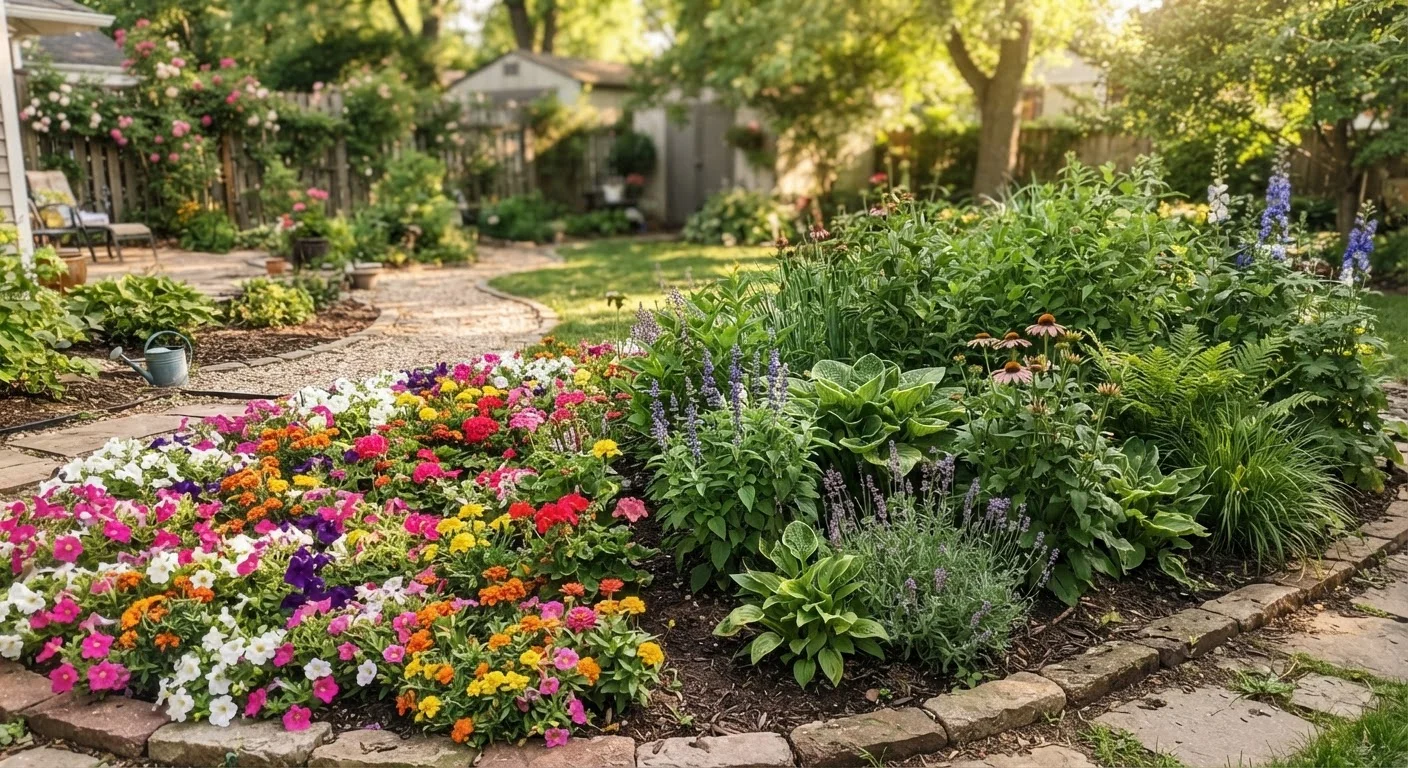
Option A
Annual plants
The reliable, season-long color option.
Best for: Gardeners who want maximum color impact each season and are willing to replant each year.
Option B
Perennial plants
The lower-cost, long-term investment.
Best for: Families who want to plant once and reduce yearly spending and labor over time.
What the terms actually mean
An annual plant completes its entire life cycle in one growing season. It germinates, flowers, sets seed, and dies, all within roughly a year or less. You plant it, enjoy it, and then it is gone. Common examples include marigolds, petunias, and zinnias.
A perennial plant lives for three or more years. The above-ground growth typically dies back in winter, but the root system survives and sends up new growth each spring. Coneflowers, black-eyed Susans, and hostas fall into this category.
There is a third group worth knowing: biennials, which take two growing seasons to complete their cycle. Most home gardeners treat them as annuals for planning purposes, since they still need replacing.
Check your hardiness zone first
Plants sold as perennials in warmer USDA hardiness zones (9 and above) may not survive winters in colder northern climates and behave as annuals in those regions. Always check the hardiness zone rating on the plant tag before buying. The USDA Plant Hardiness Zone Map is a free resource available through the USDA website and can help you confirm which plants will genuinely return in your specific location.
One practical note: plants sold as perennials in warmer USDA hardiness zones (9 and above) may not survive winters in colder northern climates and effectively become annuals there. Always check the hardiness zone rating on the plant tag before buying.
Comparing the real costs
The upfront price gap is real. Annuals typically cost $2 to $5 per six-pack at a garden center, while individual perennial plants often run $6 to $15 or more depending on the variety and pot size. If you are filling a 100-square-foot bed, annuals win on day-one spending.
The math shifts over time. A perennial planted in year one returns in years two, three, and beyond. Many perennials can be divided every few years, giving you free plants to expand a bed or share with a neighbor. Annuals require a fresh purchase every single season.
| Criterion | Annual plants | Perennial plants |
|---|---|---|
| Upfront cost per plant | Low ($2-$5 per six-pack) | Higher ($6-$15+ per plant) |
| Multi-year cost | Recurring annual purchase | One-time buy, often dividable |
| Bloom duration | Season-long (months) | Typically 2 to 6 weeks |
| Replanting required | Every year | No (returns each spring) |
| Maintenance level | Higher (annual replanting) | Lower once established |
| Layout flexibility | Full change each season | Fixed after planting |
| Seed starting viability | Easy, fast results | Possible but slower (2-3 yrs) |
Labor costs are easy to overlook. Replanting annuals each spring takes several hours of digging, amending soil, and setting plants. If your time has value (and it does), factor that in alongside the dollar cost.
Seeds offer another angle. Many annuals, including zinnias and sunflowers, grow easily from seed, which can drop the per-plant cost to cents. Some perennials also grow from seed but take longer to reach blooming size, often two to three years. For families on a tight budget, starting from seed is one of the most effective ways to stretch a garden dollar. The guide to stretching a home improvement budget has broader context on prioritizing where to spend and where to save.
Bloom time and visual impact
Annuals earn their keep through sustained color. Because the plant's entire purpose is to flower and set seed before it dies, it blooms hard all season. That gives you consistent visual impact from late spring through the first frost with relatively little intervention beyond deadheading spent blooms.
Most perennials have a defined bloom window, often two to six weeks. A coneflower bed looks spectacular in July but fairly plain in May and September. To maintain seasonal interest with perennials, you need to select varieties with staggered bloom times, which requires more planning and a larger initial variety investment.
A common approach in established gardens is to use perennials as a structural backbone and fill gaps with a handful of annuals for continuous color. This reduces the annual replanting area without losing season-long interest.
Maintenance demands across the seasons
Annuals demand the most work at the start and end of the season. Spring planting and fall cleanup take time, and you repeat the cycle every year. Mid-season care is usually light: water, occasional fertilizer, and deadheading to extend blooming.
Perennials shift the work pattern. The first growing season often requires more attentive watering as plants establish root systems. After that, a well-chosen perennial in the right spot can largely look after itself. Fall cleanup involves cutting back dead stems, and spring brings division when clumps get crowded.
Mulching matters for both types but is especially worthwhile for perennials. A 2- to 3-inch layer of mulch suppresses weeds, retains moisture, and insulates roots through winter. See the comparison of mulch, gravel, and ground cover options for cost and material guidance.
Families with limited outdoor time often find that a perennial-heavy garden, once established, requires fewer peak-season hours than one replanted with annuals each year.
Building a mixed planting strategy
The practical choice for most families is not one category or the other; it is a deliberate mix. Start with perennials in the spots you want permanent structure: along fences, borders, or around trees. Then use annuals to fill in gaps, add color to containers, or test a color scheme before committing to a permanent planting.
If budget is the main constraint this year, prioritize buying a few perennials in smaller pot sizes (they are cheaper and catch up quickly) and fill the rest of the bed with inexpensive annual seed packets. Over three to five years, as the perennials spread and multiply, your annual spending on new plants can drop significantly.
Container gardening pairs well with this approach. Annuals work well in pots because you can change them each season without disturbing in-ground perennials. If you grow vegetables as well, the same container logic applies: see the guide to starting a vegetable garden in a small yard or patio for setup ideas that work alongside ornamental plantings.
Whatever you plant, soil preparation is the one cost worth not skipping. Good compost and adequate drainage help both annuals and perennials perform better and reduce replacement costs from plant failures.
The content provided on our blog site traverses numerous categories, offering readers valuable and practical information. Readers can use the editorial team’s research and data to gain more insights into their topics of interest. However, they are requested not to treat the articles as conclusive. The website team cannot be held responsible for differences in data or inaccuracies found across other platforms. Please also note that the site might also miss out on various schemes and offers available that the readers may find more beneficial than the ones we cover.