

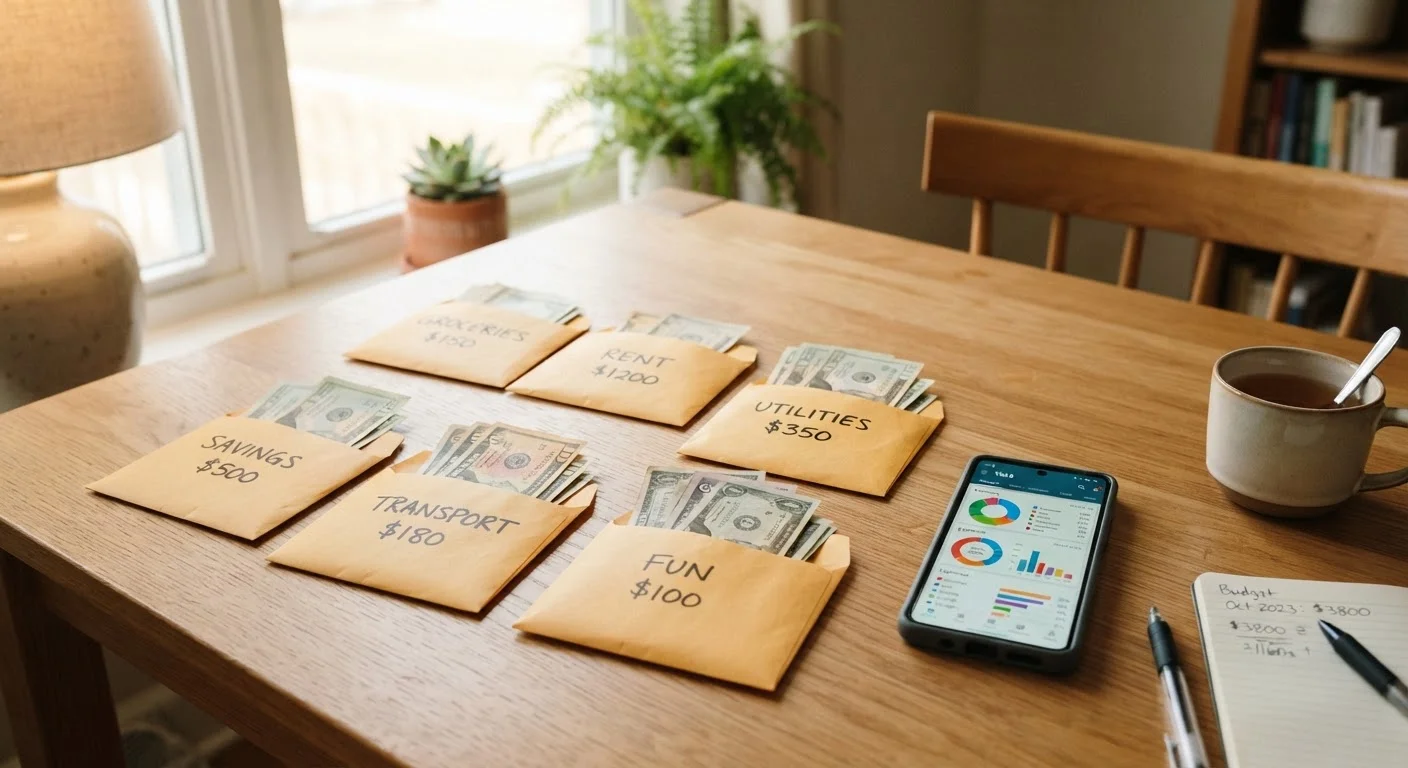
Option A
Cash envelope method
The tactile, zero-temptation spending system.
Best for: Households that want a physical, visual limit on discretionary spending and tend to overspend when using cards.
Option B
Digital budgeting apps
The connected, data-rich tracking alternative.
Best for: Families with multiple income streams, shared accounts, or a preference for real-time spending visibility across devices.
How each system works
The cash envelope method is straightforward. At the start of a pay period, you withdraw cash and divide it into labeled envelopes, one for groceries, one for gas, one for dining out, and so on. When an envelope is empty, spending in that category stops until the next pay period. No math required mid-month; the physical cash does the accounting.
Digital budgeting apps connect to bank accounts and credit cards, pulling in transactions automatically. You assign each transaction to a category, set spending limits per category, and monitor a dashboard that updates as money moves. Some apps use a "zero-based" approach where every dollar of income is assigned a job before the month starts. Others track spending passively and alert you when a category nears its limit.
If you have never built a household budget before, a plain-language starting point can help you identify your income, map your expense categories, and set realistic limits before choosing either system.
Where each method has clear advantages
Cash envelopes remove the psychological distance that cards create. Research in consumer psychology has consistently found that paying with physical cash registers as more painful than swiping, which tends to reduce impulse spending. For categories where families routinely overspend, such as groceries or takeout, that friction is useful. Grocery spending habits that keep costs predictable pair naturally with an envelope approach because the envelope sets a firm weekly ceiling.
Apps have a genuine advantage in scope. A family with a mortgage, auto loan, utility autopay, streaming subscriptions, and two credit cards cannot reasonably manage all of that with envelopes. Apps track every transaction in one place, generate spending history, and flag patterns over time. For families planning a vacation, an app's savings-goal feature can accumulate a travel fund automatically. Thinking through accommodation costs? A comparison of vacation rentals versus hotels shows why having a clear savings target in one tool is useful before booking.
| Criterion | Cash envelope method | Digital budgeting apps |
|---|---|---|
| Setup time | Minutes (cash + envelopes) | Hours (account linking, categories) |
| Works for online purchases | No | Yes |
| Handles multiple accounts | No | Yes |
| Automatic transaction tracking | No | Yes (with linked accounts) |
| Impulse-spending friction | High (cash runs out) | Low to moderate (alerts only) |
| Privacy risk | Low | Moderate (third-party data access) |
| Best for shared budgeting | Difficult to coordinate | Shared dashboards available |
| Cost | Free | Free to $15+/month |
Where each method falls short
Cash envelopes create real friction for modern household finances. Online bills, subscription renewals, and any merchant that does not accept cash cannot fit inside an envelope. Withdrawing cash also takes time and, depending on your bank, may involve ATM fees. Carrying significant cash raises security concerns that a debit card does not.
Apps have their own failure mode: they only change behavior if the user actively reviews them. Many families download a budgeting app, link accounts, and then check it sporadically. Transactions that land in the wrong category silently distort the picture. Apps also require a degree of data trust: connecting bank credentials to a third-party service is a privacy and security consideration worth weighing carefully.
For families working on specific budget areas, the same logic applies. Whether the goal is controlling spending on personal care and beauty products or home improvement projects, the system only helps if it reflects actual spending accurately and gets reviewed regularly.
A hybrid approach most families actually use
In practice, many households do not choose one system exclusively. A common pattern is to use cash envelopes for the two or three categories most prone to overspending, typically groceries, dining, and personal spending money, while relying on an app or a simple spreadsheet to track fixed expenses, savings contributions, and debt payments.
This hybrid works because it applies the psychological friction of cash where impulsive spending happens most, while using the reach and automation of digital tools for the parts of the budget that are largely set-and-forget. It also removes the awkward situation of needing cash for a purchase that really only works on a card.
The right split depends on how your household actually spends money, not on which system sounds more disciplined. Start by identifying your two or three biggest overspending categories, then ask whether a physical cash limit or a digital alert has more influence on your behavior in those moments.
This article is for general informational purposes only and does not constitute personalized financial advice. Consult a qualified financial professional for guidance specific to your household situation.
The content provided on our blog site traverses numerous categories, offering readers valuable and practical information. Readers can use the editorial team’s research and data to gain more insights into their topics of interest. However, they are requested not to treat the articles as conclusive. The website team cannot be held responsible for differences in data or inaccuracies found across other platforms. Please also note that the site might also miss out on various schemes and offers available that the readers may find more beneficial than the ones we cover.