

Start here
Why a simple routine beats a complicated one
Next
The three products every beginner actually needs
Then
How to figure out your skin type
When you're ready
Morning vs. evening: what changes and what stays
Final step
What to skip until you have the basics down
Why a simple routine beats a complicated one
Skincare aisles are designed to look overwhelming. Ten-step routines, serums for every concern, and products marketed for specific ages, seasons, or skin "types" make starting feel like a research project. It is not.
The skin barrier (the outermost layer of your skin that keeps moisture in and irritants out) functions best when you are consistent with a few compatible products rather than experimenting with many. Piling on new products quickly is one of the most common reasons beginners experience breakouts, redness, or dryness. A short, repeatable routine you actually do every day outperforms an elaborate one you do occasionally.
This is also a real win for your wallet. You do not need a cabinet full of products, and drugstore formulas can match the performance of much pricier options. If you are already thinking about how skincare fits into your monthly spending, the household budget guide is a useful place to build that structure.
The three products every beginner actually needs
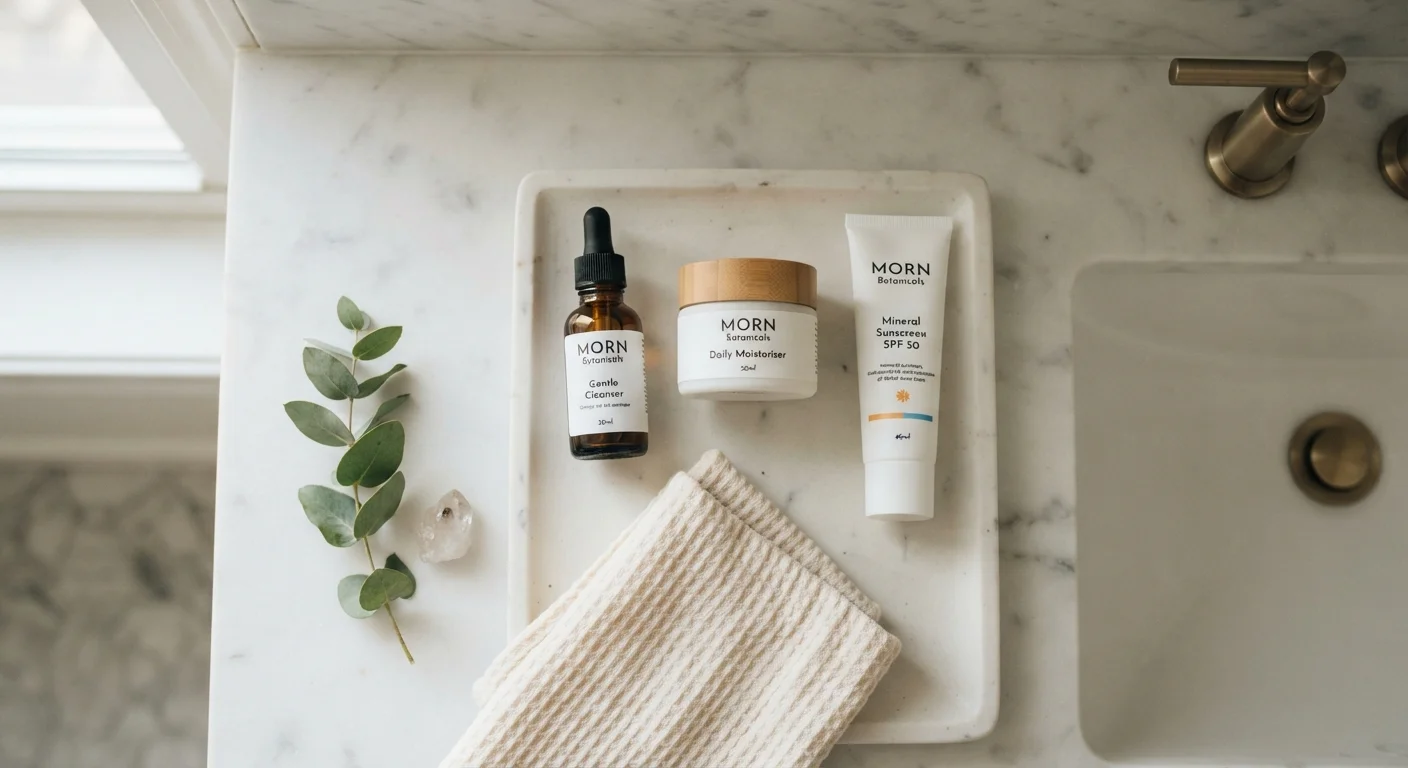
Before anything else, three categories cover the full foundation of skin health.
Cleanser
A gentle, non-stripping cleanser removes sweat, oil, and daily buildup. For most beginners, a fragrance-free, hydrating cleanser works across skin types without disrupting the skin barrier. Avoid formulas that leave your skin feeling tight immediately after rinsing; that sensation signals over-cleansing.
Moisturizer
Moisturizer keeps the skin barrier intact and prevents water loss. Even oily skin benefits from a lightweight, non-comedogenic (meaning it will not clog pores) moisturizer. Dry skin generally needs something richer with ingredients like glycerin or ceramides, which are compounds that help the skin hold moisture.
Sunscreen
Broad-spectrum SPF 30 or higher, applied every morning, is the single most evidence-backed step in any skincare routine. UV exposure is a primary driver of premature skin aging and increases skin cancer risk. This step has no optional status. For more on putting these three steps in order alongside any other products you add later, the skincare layering guide covers exactly that.
Skin barrier
The outermost layer of your skin that holds moisture in and keeps irritants, bacteria, and environmental pollutants out. Keeping it intact is the main goal of a basic skincare routine.
Broad-spectrum SPF
A sunscreen that protects against both UVA rays (which contribute to aging and pass through glass) and UVB rays (which cause sunburn). The number (like SPF 30) indicates how much UVB protection the formula provides.
Non-comedogenic
A label meaning a product is formulated to avoid clogging pores. Worth looking for on moisturizers and sunscreens if your skin tends toward breakouts.
Ceramides
Lipid (fat) molecules naturally found in the skin barrier. In skincare products, they help repair and maintain the barrier, making them a useful ingredient in moisturizers for dry or sensitive skin.
Retinoid
A vitamin A derivative used in skincare to support cell turnover and address concerns like uneven texture. Retinoids can cause irritation when first introduced and are generally not recommended as a starting-point product.
AHA / BHA
Chemical exfoliants that dissolve dead skin cells. AHAs (like glycolic acid) work on the skin's surface; BHAs (like salicylic acid) can penetrate into pores. Both are intermediate-level products, not beginner essentials.
How to figure out your skin type
Choosing products that work for you starts with a basic read of your skin. The wash test is practical and free: wash with a gentle cleanser, pat dry, and wait 60 minutes without applying anything.
- Tight feeling or visible flaking after an hour points to dry skin.
- Shine across the whole face points to oily skin.
- Shine concentrated on the forehead, nose, and chin (the T-zone) with drier cheeks points to combination skin.
- No obvious tightness or shine, feeling comfortable, suggests normal skin.
If your skin frequently reacts to new products with redness or itching, it may also be sensitive, which is an additional consideration rather than a separate type. Knowing this helps you avoid common irritants like synthetic fragrance and alcohol-based formulas.
A lot of money gets wasted on products that are not suited to a person's actual skin type. The article on skincare myths that cost money covers several misconceptions that lead people to buy things they do not need.
Morning vs. evening: what changes and what stays
The difference between a morning and an evening routine is smaller than most guides suggest. Both include a cleanser and a moisturizer. The main adjustments are around sunscreen and how thoroughly you cleanse.
Morning
Cleanse lightly (some people with dry or normal skin rinse with water only in the morning, skipping cleanser entirely), apply moisturizer, and finish with sunscreen as the last step before going outside. Sunscreen goes on after moisturizer and stays there; no other products go on top except makeup.
Evening
Cleanse more thoroughly to remove sunscreen, makeup, and the day's buildup. Apply moisturizer. If you use a treatment product like a retinoid (a vitamin A derivative that supports cell turnover, typically started after you have a stable basic routine), evening is when it goes on. Skip sunscreen at night; it serves no purpose without UV exposure.
For families managing multiple people's routines and products on a single budget, the affordable beauty for families guide has a practical category breakdown worth reading.
What to skip until you have the basics down
Many products sold as essentials are not. Toners, facial mists, eye creams, exfoliating acids, sheet masks, and serums each have their place in a more advanced routine, but none of them are required at the start. Introducing them before you have a stable baseline makes it harder to identify what is working and what is causing a reaction.
A useful rule: wait until your basic three-step routine feels comfortable and consistent (generally four to six weeks) before adding anything new. When you do add something, introduce it one product at a time with a two-to-three-week gap before the next addition.
Physical exfoliants with scrubbing particles and alcohol-based toners are worth skipping indefinitely for most people; both can damage the skin barrier without much benefit. Chemical exfoliants like AHAs (alpha hydroxy acids, such as glycolic or lactic acid) and BHAs (beta hydroxy acids, such as salicylic acid) have real evidence behind them but belong in a second phase of building your routine, not the first.
When you are ready to go further, the morning skincare routine under $30 guide shows how a full, functional routine can stay genuinely affordable.
This article is for informational purposes only and is not a substitute for advice from a licensed dermatologist or healthcare provider.
Frequently Asked Questions
Three products cover everything a beginner needs: a gentle cleanser, a moisturizer suited to your skin type, and a broad-spectrum sunscreen for daytime. Once those feel comfortable and consistent, you can consider adding targeted treatments if you have specific concerns.
Wash your face with a gentle cleanser, pat dry, and wait an hour without applying anything. If your skin feels tight or looks flaky, it leans dry. If it looks shiny all over, it leans oily. Shine only in the center of the face suggests combination skin, and if it feels comfortable with no obvious shine or dryness, it is likely normal.
Dermatologists generally recommend daily SPF even on low-sun days because UVA rays (which contribute to skin aging) pass through windows and are present year-round. A broad-spectrum SPF 30 applied each morning is considered the single most impactful skincare habit for long-term skin health.
Many drugstore formulas contain the same active ingredients found in higher-priced products. Price does not reliably predict effectiveness. What matters more is whether a product's ingredients suit your skin type and whether you use it consistently.
Most dermatologists suggest giving a new routine at least four to six weeks before judging whether it is working, since skin cell turnover takes roughly that long. Consistency over weeks matters more than the specific products you choose.
Stop using it and return to your basic routine of cleanser and moisturizer until the irritation clears. Introduce only one new product at a time, and wait two to three weeks before adding another, so you can identify the cause if a reaction occurs.
The content provided on our blog site traverses numerous categories, offering readers valuable and practical information. Readers can use the editorial team’s research and data to gain more insights into their topics of interest. However, they are requested not to treat the articles as conclusive. The website team cannot be held responsible for differences in data or inaccuracies found across other platforms. Please also note that the site might also miss out on various schemes and offers available that the readers may find more beneficial than the ones we cover.