

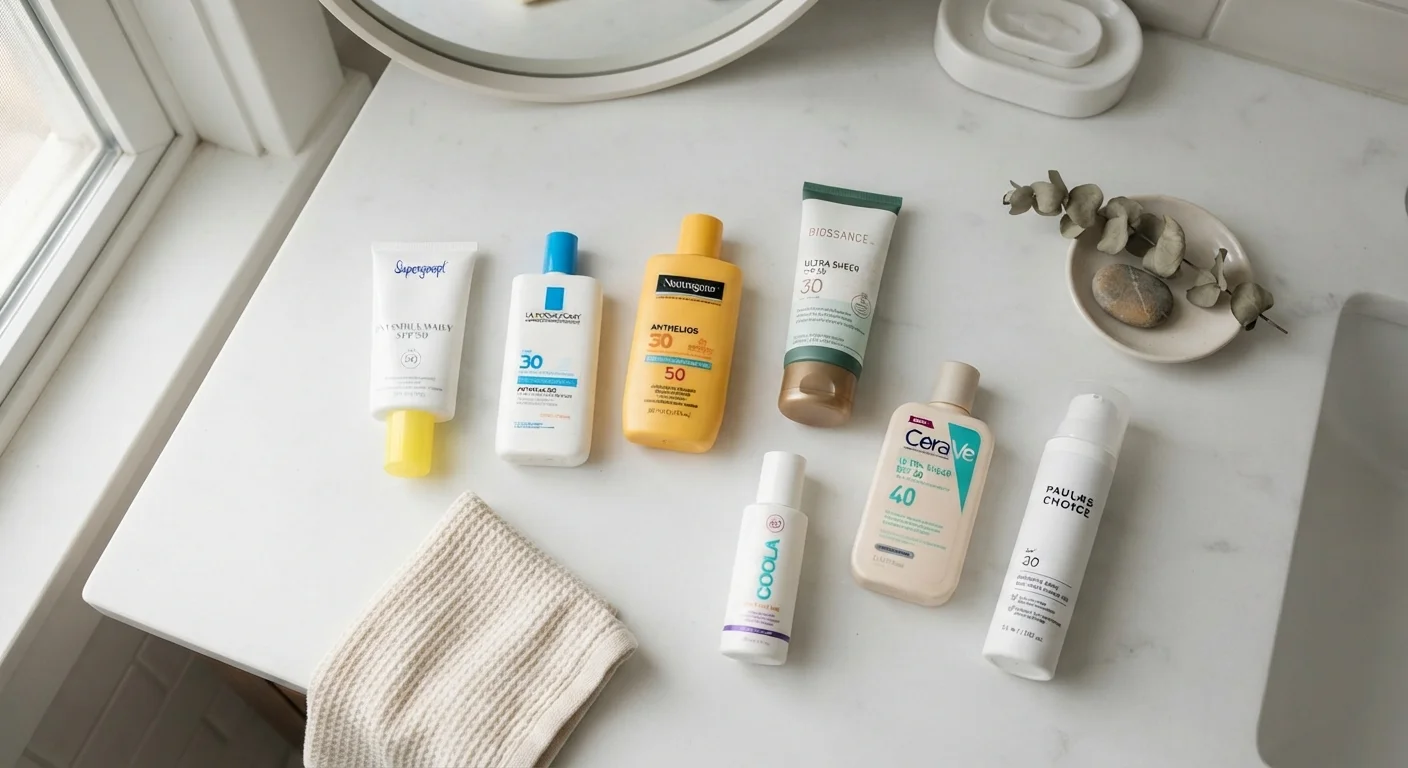
What SPF actually measures
SPF stands for Sun Protection Factor, and it measures how well a sunscreen blocks UVB rays, the wavelength responsible for sunburn and a significant contributor to skin cancer risk. The number is a ratio: SPF 30 filters out roughly 97% of UVB rays, while SPF 50 filters out about 98%. That gap sounds small, but it matters more for people with fair or sensitive skin.
SPF says nothing about UVA rays, which penetrate more deeply into skin and drive photoaging. That gap in coverage is exactly why the label needs to say more than just a number.
For most daily routines, dermatologists widely consider SPF 30 adequate when applied generously and reapplied every two hours outdoors. If your routine includes layering other products under your sunscreen, see the correct layering order to make sure SPF reaches your skin at full strength.
Broad spectrum: the UVA piece of the puzzle
SPF (Sun Protection Factor)
A measure of how effectively a sunscreen blocks UVB rays, expressed as a ratio. SPF 30 filters roughly 97% of UVB; SPF 50 filters roughly 98%.
Broad spectrum
An FDA-regulated label indicating a sunscreen has passed a test confirming it protects against both UVA and UVB rays in proportion to its SPF rating.
PA rating
A plus-sign grading system (PA+ to PA++++) originating in Japan that quantifies UVA protection using persistent pigment darkening values. More plus signs indicate stronger UVA coverage.
UVA rays
Ultraviolet A wavelengths that penetrate deeply into skin, contributing to photoaging and long-term skin damage. SPF alone does not measure protection against UVA.
UVB rays
Ultraviolet B wavelengths responsible for sunburn and a major factor in skin cancer risk. SPF directly measures a product's ability to block UVB.
Mineral filters
Active sunscreen ingredients zinc oxide and titanium dioxide that sit on the skin surface and physically scatter UV radiation.
In the United States, the FDA requires sunscreens labeled 'broad spectrum' to pass a standardized test confirming UVA protection proportional to their UVB protection. A product with SPF 15 or higher that also carries the broad spectrum label can state it helps reduce the risk of skin cancer and early skin aging.
Without the broad spectrum label, a sunscreen may do little against UVA, no matter how high the SPF number looks. When you scan a drugstore shelf, treat 'broad spectrum' as non-negotiable.
PA ratings and what the plus signs mean
PA ratings appear on many sunscreens formulated in or marketed through Asian beauty channels, and you will see them increasingly on products sold in U.S. drugstores. PA stands for Protection Grade of UVA. The system was developed by the Japan Cosmetic Industry Association and uses a plus-sign scale.
| PA+ protection level | PPD 2 to 3 (low UVA protection) (Japan Cosmetic Industry Association grading system) |
| PA++ protection level | PPD 4 to 7 (moderate UVA protection) (Japan Cosmetic Industry Association grading system) |
| PA+++ protection level | PPD 8 to 15 (high UVA protection) (Japan Cosmetic Industry Association grading system) |
| PA++++ protection level | PPD 16 or above (very high UVA protection) (Japan Cosmetic Industry Association grading system) |
| SPF 30 UVB filtration | Approximately 97% (FDA sunscreen guidance) |
| SPF 50 UVB filtration | Approximately 98% (FDA sunscreen guidance) |
PA+ through PA++++ ratings map to measured PPD values, a lab method for quantifying UVA protection. PA++ reflects PPD 4 to 7, PA+++ reflects PPD 8 to 15, and PA++++ reflects PPD 16 or above. More plus signs mean stronger UVA coverage.
PA ratings and broad spectrum are parallel systems measuring similar things by different methods. A product can carry both. If a label shows only broad spectrum without PA, that does not mean weaker UVA protection; it means the brand chose the FDA framework over the Japanese one.
Chemical vs. mineral filters: what the ingredient list tells you
Sunscreens use either chemical (organic) filters, mineral filters, or a combination. Mineral sunscreens rely on zinc oxide and titanium dioxide, which sit on the skin surface and scatter UV light. Chemical sunscreens use compounds such as avobenzone, oxybenzone, or octinoxate, which absorb UV energy and convert it to heat.
Neither category automatically outperforms the other. Mineral formulas are often recommended for sensitive or acne-prone skin because they are less likely to irritate. Chemical filters tend to be lighter in texture and easier to apply without a white cast, which matters for medium to deeper skin tones.
Drugstore shelves carry good examples of both. Reading the active ingredients panel takes seconds and tells you exactly what you are getting, regardless of price. If you are building a full morning routine around an affordable sunscreen, the morning skincare routine under $30 covers how to fit SPF into a complete, budget-friendly sequence.
Choosing a sunscreen for the whole family is also a natural part of managing affordable beauty on a family budget, where sun protection often represents some of the highest-value spending per bottle.
This article is for general informational purposes only and is not a substitute for advice from a licensed dermatologist or healthcare provider. Consult a qualified professional about any skin health concerns.
The content provided on our blog site traverses numerous categories, offering readers valuable and practical information. Readers can use the editorial team’s research and data to gain more insights into their topics of interest. However, they are requested not to treat the articles as conclusive. The website team cannot be held responsible for differences in data or inaccuracies found across other platforms. Please also note that the site might also miss out on various schemes and offers available that the readers may find more beneficial than the ones we cover.