

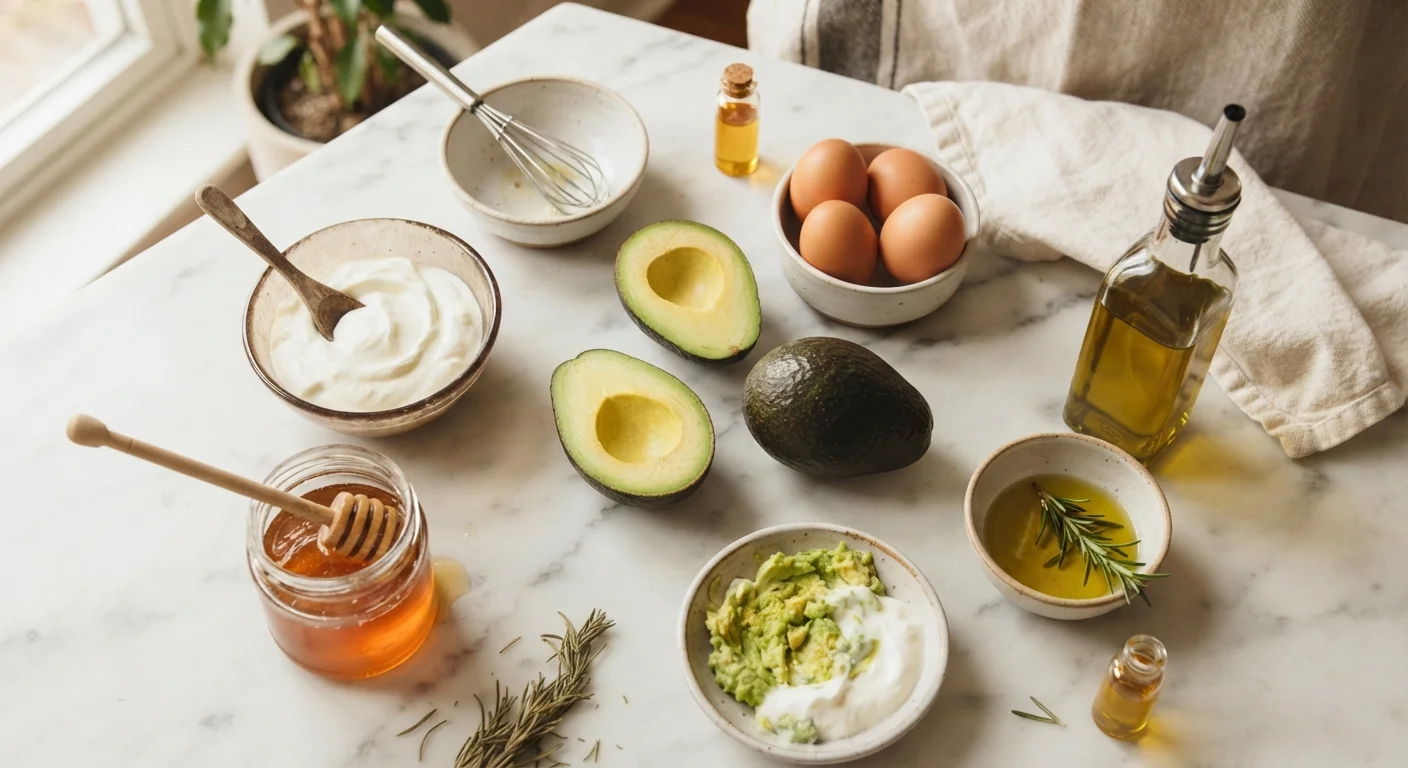
Why the kitchen seems like a logical place to start
When store-bought conditioners list ingredients like hydrolyzed protein, panthenol, and fatty alcohols, it is natural to wonder whether the avocado sitting on your counter does the same job for a fraction of the cost. Sometimes it does. The issue is that "natural" and "safe for hair" are not the same thing, and neither are "cheap" and "effective."
Hair has a specific pH range, roughly 4.5 to 5.5, and the cuticle layer that protects each strand responds poorly to anything significantly more acidic or alkaline. Many kitchen staples fall well outside that range. Others are genuinely nourishing. Knowing which is which saves your hair and your time.
Your hair's porosity also shapes how any DIY treatment performs. Understanding porosity before reaching for the pantry helps you choose ingredients that will actually absorb rather than sit on the surface or penetrate too aggressively.
Ingredients that have real conditioning value
Eggs contain both protein (in the white) and fat (in the yolk). Hair is largely made of keratin, a protein, so a brief egg mask can help temporarily patch surface damage on porous or chemically treated strands. The yolk's lipids add slip and softness. Apply to damp hair, leave on for 15 to 20 minutes, and rinse with cool water. Hot water cooks the egg and makes removal difficult.
Ripe avocado is high in oleic acid and penetrates the hair shaft more readily than heavier oils like coconut oil can on certain hair types. Mashed avocado mixed with a small amount of olive oil works as a straightforward moisture treatment for coarse or dry hair.
Plain, unsweetened yogurt contains lactic acid, a mild alpha hydroxy acid that can gently exfoliate the scalp and smooth the cuticle without drastically shifting pH. It also contains protein and fat. Keep it on for no more than 20 minutes, and rinse thoroughly, because dairy residue left behind can sour and contribute to scalp odor.
Honey is a humectant, meaning it draws moisture from the air into the hair shaft. A small amount added to a carrier oil or conditioner works well. Using it straight tends to be too sticky to rinse cleanly.
4.5-5.5
Healthy hair and scalp pH range
Hair science references consistently place the ideal pH of the hair shaft and scalp surface in this range, which most kitchen acids and alkalis fall well outside.
~pH 9
pH of baking soda
Baking soda sits far above the hair's ideal pH range, making it a common cause of DIY-related cuticle damage when used as a shampoo substitute.
Common mistakes and what to use instead
Using lemon juice as a scalp treatment or shine rinse.
Why it happens: Lemon juice is praised online for "clarifying" the scalp and adding shine, and its acidity sounds like it would tighten the cuticle.
Applying baking soda as a shampoo substitute or scalp scrub.
Why it happens: Baking soda removes buildup effectively in many household contexts, so people assume the same logic applies to hair.
Leaving an oil-heavy mask on overnight without covering the hair.
Why it happens: The idea that "more time equals more absorption" is intuitive, and overnight treatments are popular in many beauty spaces.
Using raw onion or garlic juice on the scalp for growth.
Why it happens: Some small studies have explored onion juice as a topical treatment, and that finding circulates widely without its limitations being mentioned.
Applying cinnamon or other spices directly to the scalp.
Why it happens: Cinnamon is sometimes promoted as a circulation-boosting scalp treatment in DIY beauty content.
A few practical ground rules
Patch testing matters with hair masks just as it does with skincare. Apply any new mixture to a small section of hair and a patch of skin near the hairline before using it all over. Wait 24 hours. This is especially worth doing if your scalp is sensitive or if you have any open cuts, irritation, or active dermatitis.
Frequency is another variable people overlook. Protein-rich masks (eggs, yogurt) used more than once a week on fine hair can cause stiffness and brittleness because protein overload is a real phenomenon. Moisture-focused masks can be used more freely, but the scalp generally does not need the same treatment as the lengths and ends.
If a problem, such as excessive shedding, scalp flaking, or sudden texture changes, persists after adjusting your routine, a dermatologist or trichologist can identify whether an underlying condition is at play. DIY treatments address surface conditioning, not medical scalp issues. For a broader look at how ingredient marketing can mislead, common beauty myths is worth reading alongside any new DIY routine you build.
This article is for informational purposes only and is not a substitute for professional medical or dermatological advice.
The content provided on our blog site traverses numerous categories, offering readers valuable and practical information. Readers can use the editorial team’s research and data to gain more insights into their topics of interest. However, they are requested not to treat the articles as conclusive. The website team cannot be held responsible for differences in data or inaccuracies found across other platforms. Please also note that the site might also miss out on various schemes and offers available that the readers may find more beneficial than the ones we cover.