

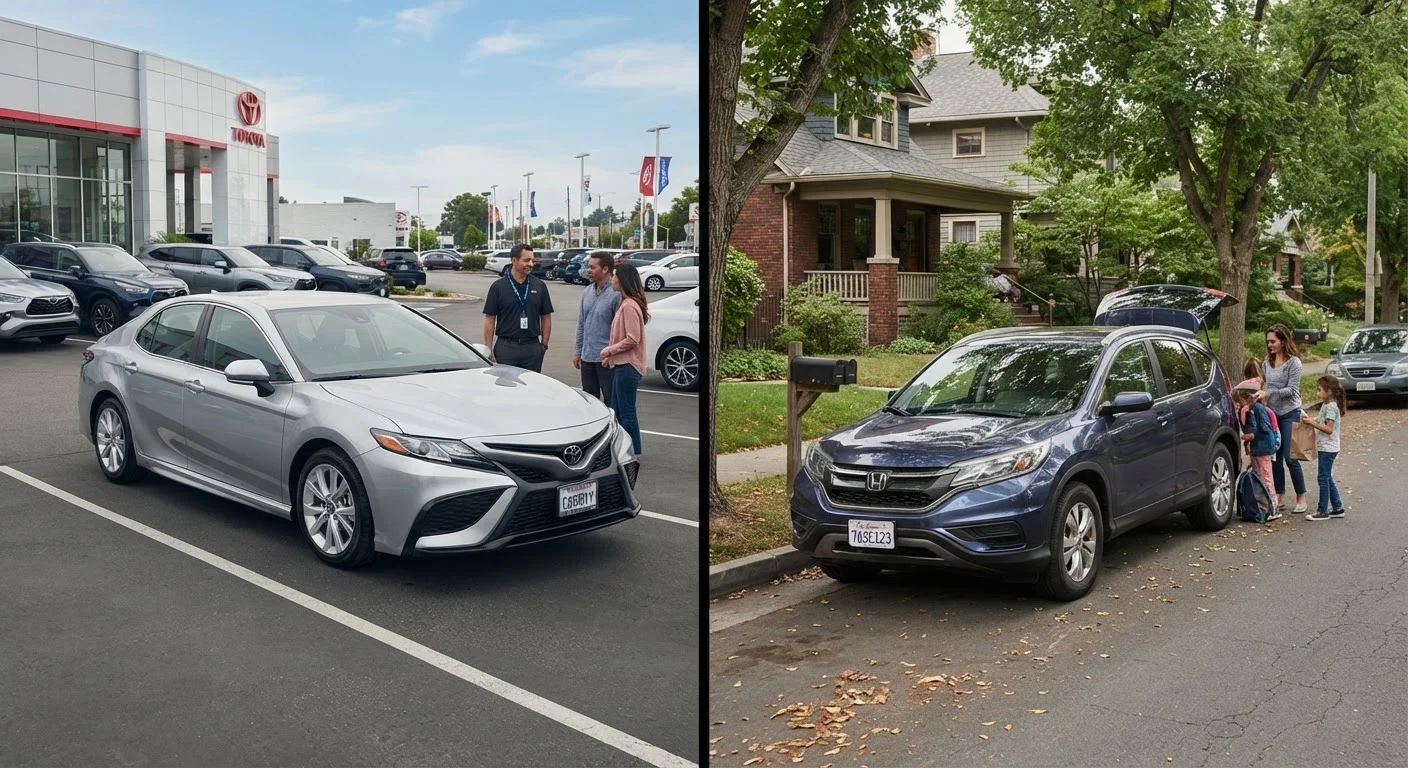
Option A
New car
The full-warranty, zero-history option.
Best for: Families who want predictable costs, modern safety features, and lower financing rates and can absorb higher depreciation.
Option B
Used car
The lower-entry-cost, faster-equity option.
Best for: Budget-conscious families who want to avoid the steepest depreciation and are comfortable managing older vehicle maintenance.
Depreciation: where the real money goes
Depreciation is the single largest cost most car owners never see on an invoice. A new vehicle typically loses around 15 to 20 percent of its value within the first year and roughly 50 percent over five years, according to data from automotive valuation sources such as Edmunds. When you buy used, a previous owner has already absorbed that steepest portion of the curve.
A family buying a three-year-old vehicle instead of a new one could be starting at 40 to 50 percent below the original transaction price, on a vehicle that still has significant useful life remaining. That gap is money that never has to be financed, insured at full replacement value, or recouped at resale.
For families planning to trade in within three to five years, the depreciation math strongly favors used. For those who intend to keep a vehicle for a decade or more, the new-car depreciation penalty spreads across more years and becomes less significant on a per-year basis. See how depreciation fits into total ownership cost for a fuller picture.
| Criterion | New car | Used car |
|---|---|---|
| Typical first-year depreciation | 15 to 20 percent | Already absorbed by prior owner |
| Financing APR (general range) | Lower (often 4 to 6%) | Higher (often 6 to 10%) |
| Loan balance | Higher | Lower |
| Manufacturer warranty | Full coverage included | Expired or partial (CPO helps) |
| Insurance cost | Higher (full coverage required) | Lower (more coverage flexibility) |
| Registration fees | Higher in most states | Lower for older vehicles |
| Near-term maintenance risk | Low | Moderate to higher |
Financing rates and total loan cost
New cars typically qualify for lower annual percentage rates (APR) than used cars. Lenders treat new vehicles as lower-risk collateral because their value is easier to establish and they carry manufacturer warranties. Used car loans often run one to four percentage points higher in APR, depending on the vehicle's age and the borrower's credit profile.
However, the loan balance on a used vehicle is usually much smaller. A family financing $20,000 at 7 percent APR over 60 months pays notably less in total interest than one financing $38,000 at 4.5 percent over the same term, even though the rate is higher on the used loan. Running the numbers on both the rate and the balance, rather than focusing on the rate alone, gives a more accurate comparison. Understanding APR, loan term, and down payment before visiting a dealership helps families evaluate offers more clearly.
Insurance, registration, and ongoing costs
Insurance premiums are calculated partly on a vehicle's replacement value. A newer, more expensive car costs more to insure, and lenders typically require comprehensive and collision coverage for the life of a financed loan. On an older used vehicle with no outstanding loan, a family can choose to carry only liability coverage, which can reduce annual premiums substantially.
State registration fees in most of the US are also tied to vehicle age or value, so a used car generally carries a lower annual registration cost. These recurring savings accumulate over time and are easy to overlook when comparing sticker prices.
Maintenance is where used cars can shift the equation back toward new. Older vehicles may need tires, brakes, belts, and other wear items sooner. A certified pre-owned (CPO) vehicle, which has passed a manufacturer inspection and carries an extended warranty, reduces that uncertainty at a cost that sits between a standard used car and a new one. Before buying any used vehicle, a pre-purchase inspection checklist can surface problems that affect the real cost of ownership.
~20%
New car value lost in year one
Automotive valuation sources including Edmunds estimate new vehicles lose roughly 15 to 20 percent of their value within the first 12 months.
~50%
Value remaining after 5 years
A typical new vehicle retains around half its original purchase price after five years of ownership, with variation by make and model.
1 to 4 pts
Extra APR on used car loans
Used vehicle loans commonly carry interest rates one to four percentage points above comparable new car loan rates, depending on vehicle age and credit profile.
Which choice fits your family's situation
The honest answer is that neither option is universally better. A family with strong credit, a need for the latest safety technology, and a plan to keep the vehicle long-term may find that buying new makes sense. A family managing a tighter monthly budget, comfortable with some maintenance variability, and planning to buy a vehicle that is three to five years old will likely come out ahead financially in the short to medium term.
Leasing is a separate path worth understanding before committing to either purchase route. Leasing versus buying carries its own financial structure that suits some family situations better than an outright purchase of either a new or used vehicle.
This article provides general financial information for educational purposes and is not personalised financial or purchasing advice. Vehicle pricing, interest rates, and ownership costs vary by market, credit profile, and individual circumstances. Consult a qualified financial professional before making decisions specific to your situation.
The content provided on our blog site traverses numerous categories, offering readers valuable and practical information. Readers can use the editorial team’s research and data to gain more insights into their topics of interest. However, they are requested not to treat the articles as conclusive. The website team cannot be held responsible for differences in data or inaccuracies found across other platforms. Please also note that the site might also miss out on various schemes and offers available that the readers may find more beneficial than the ones we cover.